
Does Hazelnut Flavored Coffee Contain Nuts?

Most hazelnut flavored coffee contains no nuts, because the taste comes from a flavoring oil applied to roasted beans. A coffee label must still declare hazelnut whenever the product contains hazelnut protein. Section 343(w)(4) of title 21 of the United States Code (U.S.C.) extends that duty to flavorings.
The words natural flavor settle where a compound came from, not whether a nut was involved. Cross-contact in a shared facility stays invisible on the panel, so a severe allergy needs the roaster's own answer.
Does Hazelnut Flavored Coffee Contain Nuts?
No, most hazelnut flavored coffee does not contain nuts. That taste comes from post-roast flavoring oil rather than nut content. Six independent roasters and coffee publishers agree on that point. Colipse Coffee follows the same method and names natural hazelnut extract on its product page. A minority of products do use real hazelnut, so the label decides the answer for any given bag.
Nut content in hazelnut flavored coffee varies by product rather than by category. Organic Coffee Co. describes its Hazelnut Creme as flavored with raw, wild German hazelnuts. Roaster guidance also describes blends that grind real roasted hazelnuts in with the coffee.
Those products are the exception rather than the rule. Federal law closes the gap for anyone who needs certainty.
Federal allergen labeling reaches flavorings as well, per the labeling section below. A bag whose flavoring contains hazelnut protein has to say so.
How Do Roasters Make Coffee Taste Nutty Without Nuts?
Roasters make coffee taste nutty without nuts by coating warm roasted beans with a flavoring oil. The oil rebuilds roasted hazelnut aroma from food-grade flavor compounds. Coffee itself supplies none of that aroma.
The flavoring step happens after the roast, never before. Roasted beans are microscopically porous, so a roasted bean absorbs oil the way a sponge absorbs water. Roasters dose the oil at roughly 3 percent of bean weight.
Our guide to how flavored coffee is made breaks that process down step by step.
Propylene glycol is the usual carrier that keeps the flavor compounds dispersed. Nut protein has no role in any of those steps. Death Wish Coffee states on its chocolate hazelnut page that its natural flavors are refined to remove allergenic protein.
Is Coffee Itself a Tree Nut?
No, coffee is not a tree nut. Coffee beans are seeds of the Coffea plant, a member of the Rubiaceae family. The federal list of major food allergens at 21 U.S.C. 321(qq)(1) does not include coffee.
The major food allergen list names milk, egg, fish, Crustacean shellfish, tree nuts, wheat, peanuts, soybeans and sesame. Coffee is absent from that list. Plain unflavored coffee therefore poses no tree nut risk from the bean itself.
Risk enters a hazelnut coffee through two routes only. The first route is an added flavoring that contains nut protein. The second route is cross-contact during roasting, grinding or packing.
Do Hazelnut Tasting Notes Mean Added Hazelnut?
No, hazelnut tasting notes do not mean added hazelnut. A tasting note describes an aroma compound the bean developed through its origin and roast. The bag prints that note as a descriptor, not as an ingredient.
Tasting notes and added flavorings are two different things sharing one word. A specialty roaster writing hazelnut finish is describing what the cup smells like. That coffee has nothing added to it.
A bag marked hazelnut flavored has been through a real flavoring step. Wording on the front of the bag separates the two cases fastest.
The word flavored signals an addition. A bare tasting note does not.
Does Natural Flavor Mean the Coffee Contains Hazelnut?
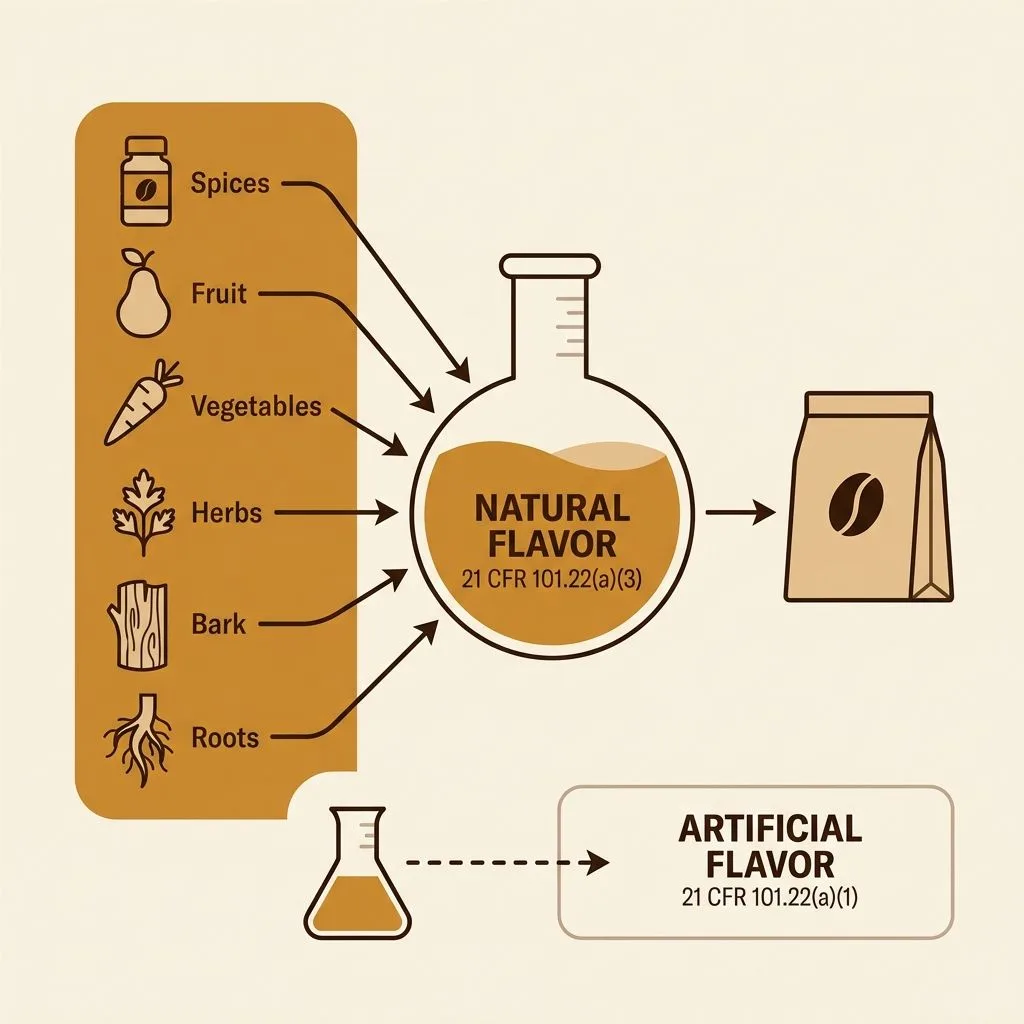
No, natural flavor does not mean the coffee contains hazelnut. The phrase describes where a flavor compound came from, not which food it imitates. A natural hazelnut flavor can be built entirely from plant sources other than nuts.
Section 101.22(a)(3) of title 21 of the Code of Federal Regulations (CFR) defines a natural flavor by source. Qualifying sources include spices, fruit, vegetables, edible yeast, herbs, bark, buds, roots and leaves. Meat, seafood, poultry, eggs, dairy products and their fermentation products qualify as well.
Under 21 CFR 101.22(a)(1), an artificial flavor is any flavor substance drawn from outside those sources. Real hazelnut coffee labels sit on both sides of that line. Dunkin' sells Hazelnut Artificially Flavored Ground Coffee, and 21 CFR 101.22(i)(2) is why the word artificial appears there.
Fresh Roasted Coffee states that its flavors are a blend of natural and artificial. Jim's Organic Coffee and Verena Street state all-natural hazelnut flavoring instead. None of those four statements answers the nut question on its own.
Must a Coffee Label Declare Hazelnut as an Allergen?
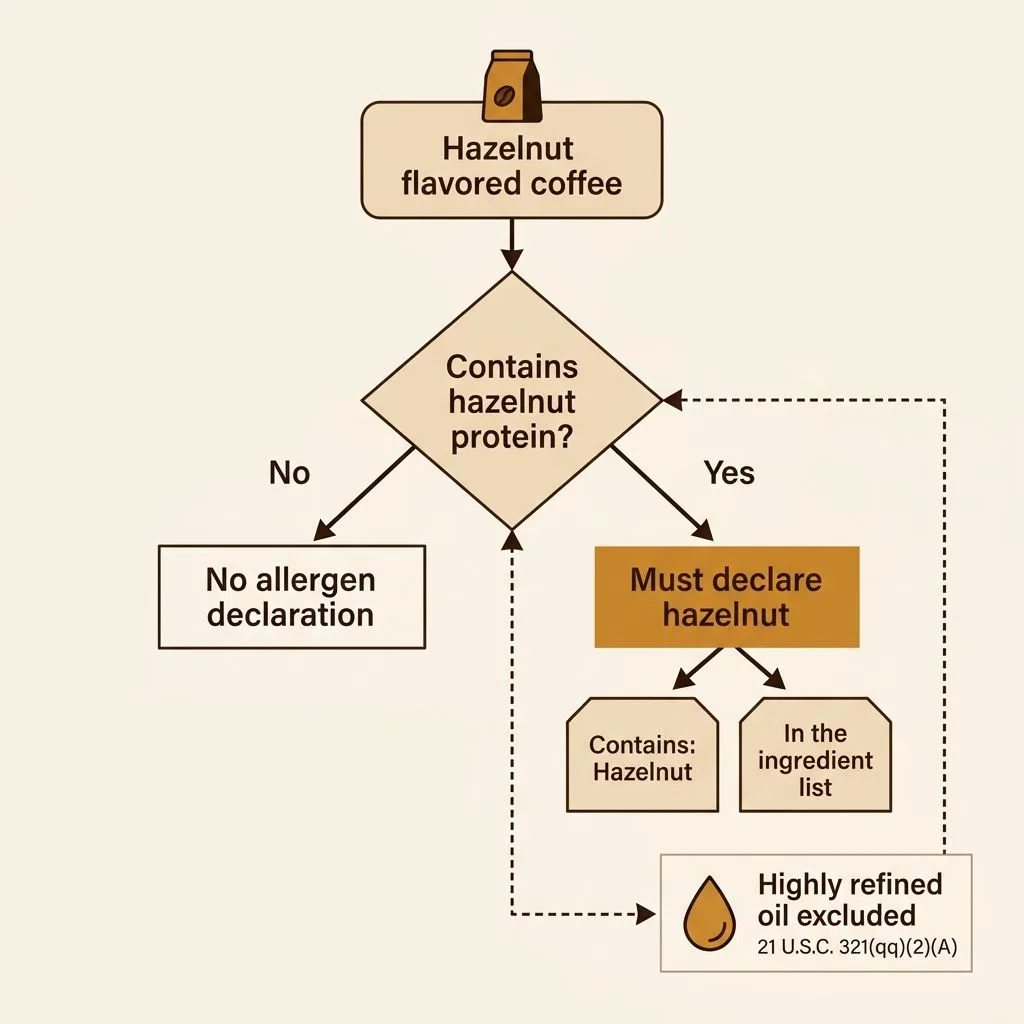
Yes, a coffee label must declare hazelnut as an allergen whenever the product contains hazelnut protein. 21 U.S.C. 343(w)(4) extends that duty to flavorings. A flavoring is not exempt because it is a flavoring.
Allergen declaration follows one of two fixed formats. Under 21 U.S.C. 343(w)(1)(A), the word Contains plus the food source name sits next to the ingredient list. That wording may be no smaller than the type used in the ingredient list. Under 21 U.S.C. 343(w)(1)(B), the food source name appears in parentheses inside the ingredient list.
21 U.S.C. 343(w)(2) then requires the specific nut name, so a label must say hazelnut rather than tree nut. Filbert is the other name for hazelnut. Filbert remains on the Food and Drug Administration (FDA) tree nut list, per the agency's January 2025 allergen guidance.
One real exclusion narrows all of this. 21 U.S.C. 321(qq)(2)(A) excludes any highly refined oil derived from a major food allergen. A hazelnut-derived flavor ingredient stripped of its protein can therefore sit outside the declaration rule.
Is Hazelnut Flavored Coffee Safe With a Tree Nut Allergy?
Yes, hazelnut flavored coffee is safe for most people with a tree nut allergy. That finding is a pattern rather than a guarantee. Most products contain no nut protein at all. A minority do contain it, and cross-contact adds a risk the ingredient list never shows.
Tree nut allergy severity varies widely between individuals, so a category answer cannot replace medical advice. Hazelnut protein is also unusually durable, which makes processing heat a weak safeguard. A 2015 study by S. Pfeifer and colleagues tested Cor a 14, the 2S albumin allergen of hazelnut.
The work appeared in Molecular Nutrition and Food Research. The team used circular dichroism spectroscopy on the purified protein. They found that temperatures above 80 degrees Celsius (176 degrees Fahrenheit) were needed before Cor a 14 began to unfold. The protein refolded once samples cooled to 20 degrees Celsius.
Simulated digestion left it intact through two hours of gastric pepsin, then trypsin and chymotrypsin. Heat treatment did not significantly reduce immunoglobulin E (IgE) binding in patient sera. Anyone with a diagnosed tree nut allergy should confirm a specific product with the roaster and an allergist.
Can Hazelnut Coffee Pick Up Nuts Through Cross-Contact?
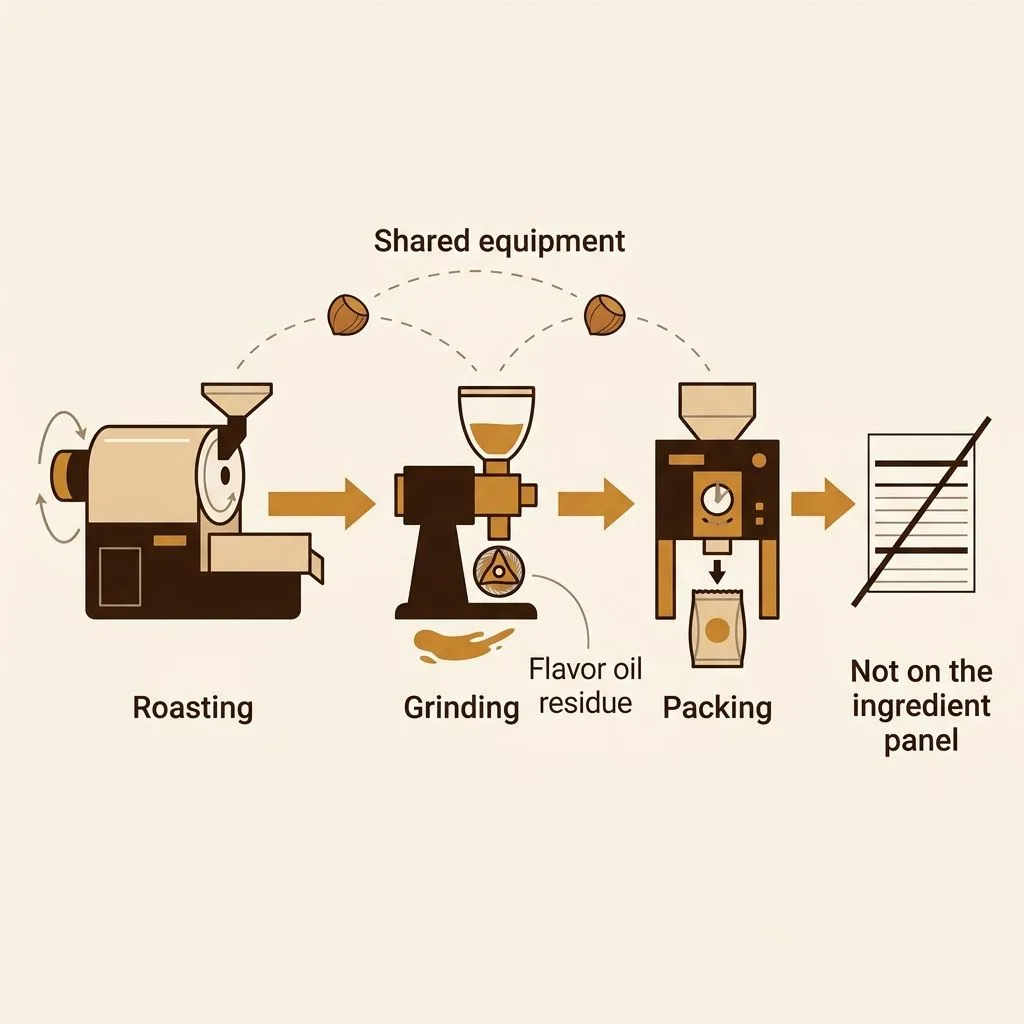
Yes, hazelnut coffee can pick up nuts through cross-contact. Shared roasting, grinding and packing equipment moves trace material between products. An ingredient list does not capture that route at all.
Cross-contact happens at the equipment stage, after the recipe is already fixed. Flavor oils leave a sticky residue inside a grinder. That residue transfers to whatever gets ground next.
A facility that also handles nuts creates the same exposure through shared equipment and storage. Advisory wording is where buyers usually look for an answer instead. Phrases such as may contain and produced in a facility that also processes are voluntary.
FDA does not require them, per the January 2025 guidance cited above. The agency also states that an advisory statement is no substitute for manufacturing controls on cross-contact. Absence of a warning is therefore not evidence of a nut-free line.
Does Hazelnut Syrup Contain Hazelnut?
No, hazelnut syrup usually contains no hazelnut. Syrup is a separate product from hazelnut flavored beans, added to the cup after brewing. An allergist review of four hazelnut syrup brands found hazelnut in none of them.
Hazelnut syrup reaches the coffee by a different route than a flavored bean does. A barista pumps the syrup into the finished drink.
The Starbucks hazelnut syrup ingredient statement lists sugar, water, natural and artificial flavours, potassium sorbate and citric acid. Hazelnut appears nowhere on that statement.
Syrup brands still vary, and no single check covers the whole category. A syrup built on true hazelnut oil would carry real allergen risk. The flavoring rule above covers syrup identically, so a hazelnut-protein syrup must declare it.
How Do You Check a Hazelnut Coffee for Nuts?
You check a hazelnut coffee for nuts by reading the ingredient panel and the Contains line together. The flavoring entry names its source when nut protein is present. Anything the panel leaves open goes to the roaster directly.
Front-of-bag wording tells you less than the panel does. Natural flavor names a source category only, per the definition above. A Contains: Hazelnut line is the single mandatory allergen signal on the bag.
Silence on that line is meaningful but incomplete, because cross-contact never appears there. Written confirmation from the roaster covers what the label cannot. The table below sets out what each signal on a bag actually establishes.
| Signal on the bag | What it establishes | What it does not establish |
|---|---|---|
| Hazelnut Flavored | A flavoring was added after roasting | Whether that flavoring came from nuts |
| Hazelnut as a tasting note | An aroma from origin and roast, no addition | Nothing about the facility |
| Natural flavor in the ingredient list | The compound came from a qualifying source under 21 CFR 101.22(a)(3) | Which specific food that source was |
| Artificially flavored on the front | The flavor sits outside the natural-source definition | Whether any nut material is present elsewhere |
| Contains: Hazelnut | Hazelnut protein is present, per 21 U.S.C. 343(w)(1) | How much is present |
| May contain tree nuts | The maker chose to flag a cross-contact risk | A measured level, since the statement is voluntary |
| No allergen statement at all | No declarable hazelnut protein in the recipe | That the line is free of cross-contact |
Does Snickers Flavored Coffee Contain Nuts?
Snickers flavored coffee raises the same label question as hazelnut coffee. Its peanut taste comes from flavoring applied to the roasted beans. Peanuts are a major food allergen under the same law covered above.
The label rules in this article decide the answer for any given bag. A flavoring that contains peanut protein must be declared. Allergy shoppers should read the Contains line and any advisory statement before buying.
The flavoring on the bean tells you less about a bag than the panel on the back does. Start with our picks for the best flavored coffee beans.