
How to Make Flavored Coffee
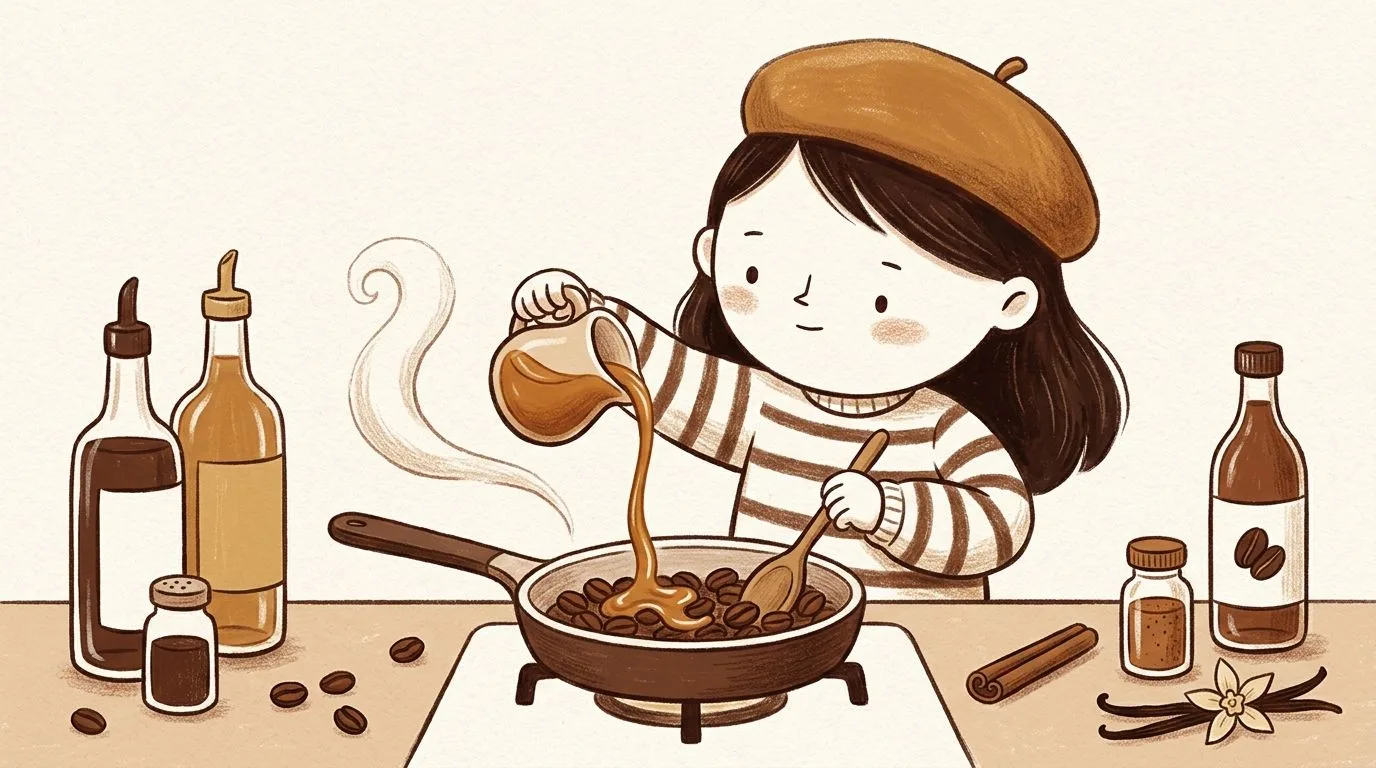
You make flavored coffee at home by one of three routes. You flavor the grounds, the whole beans, or the finished cup. Use no more than 3 percent of the coffee's weight in flavoring.
Commercial roasters work to that same ceiling. Spices, extracts, syrups, oils and creamers each suit a different route. Most home flavoring failures are dose or timing errors. Storage decides how long any of your work lasts.
How Do You Make Flavored Coffee at Home?
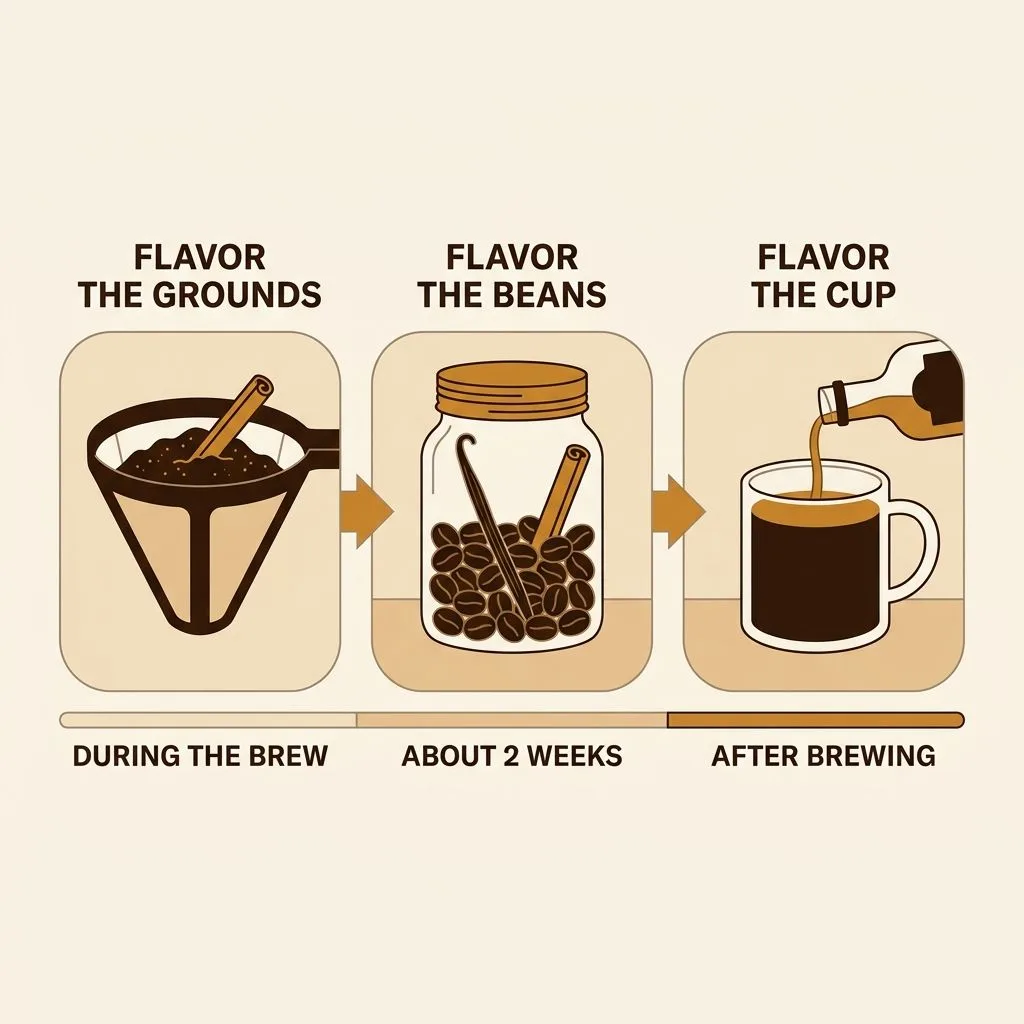
You make flavored coffee at home by one of three routes. You flavor the grounds before brewing, you flavor whole beans in storage, or you flavor the finished cup. All three work in an ordinary kitchen. None of them needs roasting equipment.
Commercial roasters use a fourth route you cannot copy. Flavor oil is applied to beans still warm from the roaster, in a tumbling mixer. Our guide to how flavored coffee beans are made covers that machinery and its dose.
Your kitchen has no warm-from-the-roaster window. Home methods work on time and contact instead of heat. The grounds route flavors during the brew itself.
The bean route flavors over days in a sealed jar. The cup route flavors after brewing, using a syrup, extract or creamer. Choose the route by how much lead time you have.
None of the three adds sugar on its own. The calories in flavored coffee arrive only through a syrup, a creamer or milk.
What Can You Flavor Coffee With?
You can flavor coffee with spices, extracts, syrups, flavoring oils, creamers or cocoa. Spices and cocoa add flavor with no calories. Syrups and creamers add both flavor and sugar. Extracts and oils sit between the two.
Cinnamon, nutmeg, cardamom, cloves, allspice and ginger are the standard spice options. Vanilla, almond, peppermint, coconut, hazelnut and orange cover most extract shelves. Flavoring oils made for coffee carry no sugar and work at one to two drops.
Extracts work at two to three drops per cup. Ground spice starts at a quarter teaspoon per cup. Unsweetened cocoa powder, citrus zest, dried berries and ground nuts flavor coffee with no carrier solvent.
Whole fruit is the one option worth avoiding. Whole fruit turns the brew bitter, so use peel, zest or juice instead.
How Do You Flavor Coffee Grounds Before Brewing?
You flavor coffee grounds by layering the flavoring on top of them in the basket. The brew water then carries that flavor through. Layering works better than stirring the spice through the grounds.
Whole spices suit a drip basket better than powdered ones. Powdered spice clogs the basket and should stay out of it. A tested drip dose is 75 grams of coffee with one crushed cinnamon stick.
Two cloves and the zest of half an orange go in with it. A second dose is 75 grams of coffee with 7 grams of crushed green cardamom. A third is 50 grams of coffee with 25 grams of chicory granules.
Each dose brews with 1 litre of water and yields about four 8 fluid ounce cups. For a shelf jar, whisk the batch dose given further down into half a cup of grounds. Ground spice, an extract or cocoa all work there.
The simplest version is 2 to 3 tablespoons of ground cinnamon in a heaping cup of ground coffee. Your brew method decides the timing. A French press takes dry spice with the grounds and liquid flavor after pressing. Espresso takes liquid flavor after the shot, never before.
How Do You Flavor Whole Coffee Beans?
You flavor whole beans by sealing them in an airtight container with a flavoring and waiting. The beans absorb the aroma over about two weeks. No heat and no equipment are involved.
Roasting is what makes the absorption possible. Roasting leaves the bean microscopically porous, so the bean takes up an applied oil or aroma. The home ratio is one part flavoring to two parts coffee, held several days before grinding.
Cinnamon sticks suit the method better than ground spice, because whole spice leaves no dust in the jar. Freshness sets your deadline. Roasted beans start losing freshness about a month after roasting, so the infusion must finish inside that window.
Store the jar in a dark, cool place away from direct sunlight. Green beans can also be soaked or fermented before roasting, including by carbonic maceration. That route needs a home roaster and a steep learning curve.
Grind flavored beans separately from plain ones. Flavor oils leave a sticky residue in a grinder that transfers to whatever you grind next.
How Much Flavoring Should You Use?
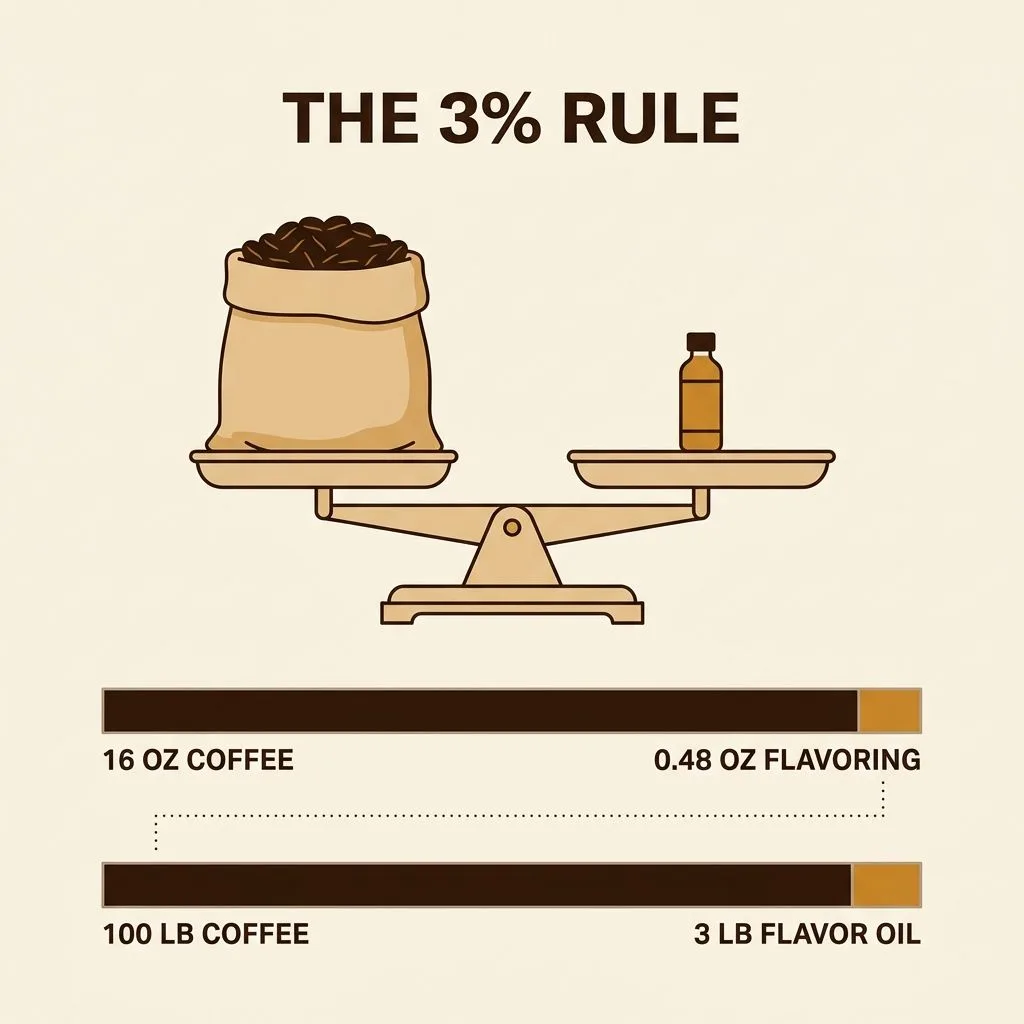
Use no more than 3 percent of the coffee's weight in flavoring. The 3 percent rule is the commercial standard and the home ceiling alike. Above that dose the cup turns harsh and chemical.
Worked out on a real batch, 3 percent is a small amount. One pound of beans, or 16 ounces, takes 0.48 ounces of flavoring. Per pot, 2 teaspoons of flavoring goes into half a cup of ground coffee.
That half cup is enough for about 10 servings. Whole-spice doses run higher by weight, because whole spice releases less flavor than a concentrate. The three drip doses above are measured in grams of spice against grams of coffee, never in percent.
All three sit against a standard brewing ratio of 55 grams of coffee per litre of water. The accepted margin on that ratio is plus or minus 10 percent. Start under your target and build up. You can always add more flavoring to the next pot.
How Do You Make Coffee Syrup at Home?
You make coffee syrup by simmering equal parts sugar and water. Bring the mixture to a gentle boil and stir until the sugar dissolves. Simmer 15 to 20 minutes, then cool the syrup before bottling.
Flavor goes in after the sugar has dissolved, not at the start. Extracts, ground spice, caramel sauce and crushed peppermint all work at that point. Fruit needs one extra step.
Puree the berries with water and strain to juice before the sugar goes in. Crystallising is the common failure. Syrup crystallises when it meets a cold pan or a cold spoon.
A little lemon juice, corn syrup or cream of tartar prevents that. Refrigerated syrup keeps about two weeks. A tablespoon of vodka stretches the syrup to about a month.
Homemade syrup is not automatically lighter than the bought kind. One tablespoon of the basic recipe carries about 48 calories and 12 grams of sugar. Two tablespoons of a leading commercial vanilla syrup carry 20 grams of sugar.
Dose the syrup the way a cafe does. One pump equals one tablespoon, and a 16 fluid ounce drink takes four pumps.
How Do You Make Flavored Coffee Creamer?
You make flavored coffee creamer from two ingredients plus a flavor. Shake one 14 ounce can of sweetened condensed milk with 1 and three quarter cups of milk or cream. Add your flavoring to that base.
Fat content sets the texture. Skim milk gives a thin creamer and heavy cream gives a thick one. Two teaspoons of an extract turns the base into a named flavor.
Two to three tablespoons of a chocolate or caramel sauce does the same job. Dry or thick additions need warming first. Whisk the cinnamon or honey into a few tablespoons of the base and warm it, or the creamer stays grainy.
You can skip the can entirely. Warm milk, cream, sugar and salt for about ten minutes until the mixture foams. The foamed mixture is your condensed base.
Keep the finished creamer in an airtight container in the fridge. Use the creamer within about seven days and shake it before each pour. Remember what a creamer adds to the cup. A flavored bean contributes flavor and nothing else, while a creamer contributes fat and sugar.
How Do You Make Your Own Coffee Extracts?
You make coffee extracts by steeping flavoring material in 80 proof vodka. Seal the material in a glass bottle, keep it dark and shake it weekly. Strain the liquid when the steeping time is up.
Steeping times run four to six weeks. Three vanilla beans in one cup of vodka need about six weeks. One source gives about five weeks for the same three-bean quantity, so six weeks is the safer figure.
Half a cup of nuts in one cup of vodka needs four weeks. Two orange peels in one cup of vodka need four weeks as well. Federal law sets the benchmark your homemade version is aiming at.
Under 21 CFR 169.175, vanilla extract must contain not less than 35 percent ethyl alcohol by volume. The same section requires not less than one unit of vanilla constituent per gallon. Section 169.3(b) of title 21 of the Code of Federal Regulations defines that unit as 13.35 ounces of vanilla beans.
Those beans must carry no more than 25 percent moisture. Vodka at 80 proof is 40 percent alcohol, so the alcohol side of the standard is met. A finished extract stores indefinitely in a sealed airtight jar.
How Do You Store Homemade Flavored Coffee?
Store homemade flavored coffee by matching the container to the ingredient. Beans, spices, syrups and creamer each hold their flavor for different lengths of time. Air is the common enemy across all four.
Beans reward room temperature over the freezer, at first. Fresh room-temperature beans brew slightly more flavorful coffee than frozen ones. Oils on chilled beans congeal and release their flavor less readily.
After a month the result reverses. Frozen beans then beat counter-stored beans, because oxygen has degraded the ones left out. Buy beans weekly and keep them on the counter, or buy less often and freeze them.
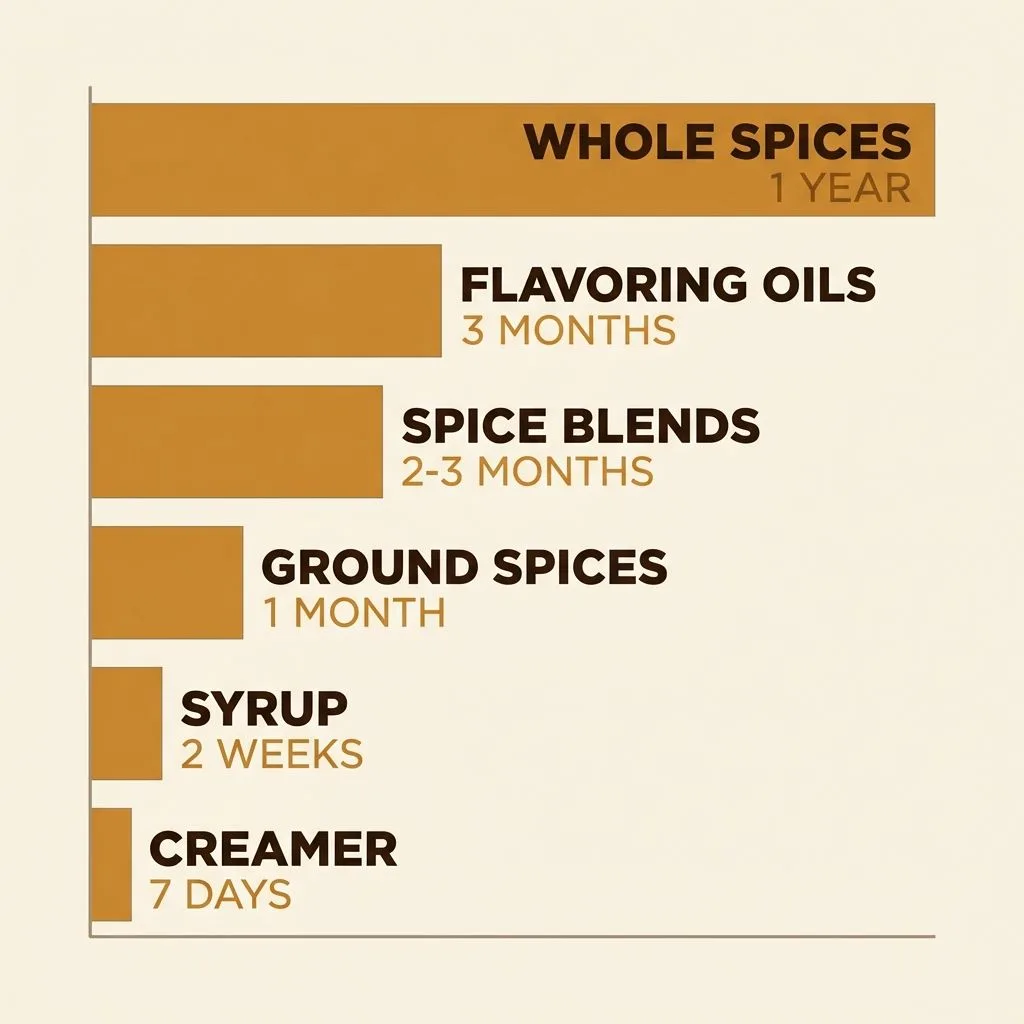
Ground spices hold about a month. Whole spices hold about a year, spice blends two to three months, and flavoring oils about three months. Grind spice in short bursts and sift it before use. Label the jar with the date, because a spice that smells dusty has already lost the cup.
Why Does Homemade Flavored Coffee Taste Weak or Bitter?
Homemade flavored coffee tastes wrong for two reasons: dose and timing. Too much flavoring buries the coffee underneath it. Flavoring added at the wrong moment turns bitter.
Halve your flavoring and build back up if the coffee has vanished. Cinnamon and peppermint overwhelm a cup fastest. Bitterness is a timing fault rather than a quantity one.
Spices added too early in the brew turn bitter, so stir extracts and oils in after brewing. Nutmeg and clove intensify with heat and need smaller amounts than the others. Weak or uneven flavor points at your ingredients, not your dose.
Spice and oil past the freshness windows above have already lost their strength. Stir the cup through after adding anything, and stir iced drinks a second time before drinking. An off or strange taste means something has spoiled.
Rancid oils, crystallised syrup and stale nuts each throw the cup. One fault no flavoring fixes is a bad bean underneath. Flavoring is sometimes used to mask low-grade or stale coffee, and the added flavor does not repair it. Start with beans you would happily drink black.
Is a Homemade Flavoring Safer Than a Bought One?
Homemade flavoring skips the propylene glycol carrier that commercial oils use. That carrier is affirmed safe for food, so whether flavored coffee is bad for you rarely turns on it. Nut allergies and poured-in sugar matter more.
How Do You Make Snickers Flavored Coffee at Home?
Snickers flavored coffee follows the same home methods this guide covers. A homemade version blends strong coffee with milk, peanut butter, caramel sauce and chocolate sauce.
The store route skips the blender. Snickers ground coffee and Donut Shop Snickers K-Cups arrive already flavored. Both brew like any flavored coffee described above.
You can also skip the work entirely. Want flavored coffee that already tastes like the dessert on the bag? Start with our picks for the best flavored coffee beans.